
Total quotes: 36 quotes
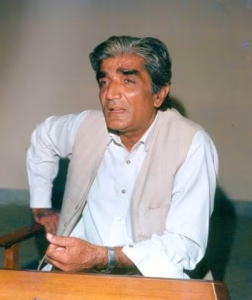
Hz. Wasif Ali Wasif Reh (15 January 1929 – 18 January 1993) stands among the most influential Sufi intellectuals and spiritual reformers of Pakistan. Revered as a mystic of the modern age, he was an educationist, writer, poet, spiritual guide, and a visionary whose wisdom continues to shape millions of hearts.
He became famous for his distinctive literary style, writing short yet profound pieces of prose on universal themes — love, life, fear, hope, destiny, patience, prayer, happiness, and inner awakening. His words carry the fragrance of Sufism while touching the practical realities of everyday life.
Today, he is considered one of the most quoted writers in Urdu literature, and his style of writing is recognized as the “Wasifian Style” — concise, soulful, and deeply impactful.
Wasif Ali Wasif’s weekly columns in Daily Nawa-i-Waqt created a wave in literary circles. His first published column, “Muhabbat” in 1984, left readers astonished with its mystical depth and simplicity.
During his lifetime, his writings were compiled into immortal books such as Dil Darya Samandar, Qatra Qatra Qulzam, and Harf Harf Haqeeqat, which remain spiritual classics for seekers worldwide.
His thought system, Wasfiyat, is a powerful blend of mysticism, ethics, and patriotic spirit- uniquely merging Pakistanism with Sufism. Many MPhil and PhD theses have been devoted to his life and teachings, and some scholars have rightfully described him as مصلحِ پاکستان — “Reformist of Pakistan”, placing him in a continuum with thinkers like Allama Iqbal.
Deeply rooted in the Qur’an and Hadith, his message reveals the inner essence of Islam — purity of heart, sincerity in action, and devotion to the Divine. He possessed a rare gift: the ability to create a “rainbow of meanings” through just a few words. For this reason, he is widely regarded as the pioneer of modern aphorism in Urdu literature, and his legacy continues to enlighten seekers across generations.
At WisdomBee, our mission is to preserve, honor, and share the timeless teachings of Wasif Ali Wasif (R.A) bringing his spiritual insight to modern readers in a language that heals, nourishes, and transforms the soul.
Orators here talk about the insecurity of times but they themselves are building their houses, with the conviction of security.
A hypocrite is a person whose actions in life are incompatible with his belief. Such a man gives up neither sin nor prayer. Allah is his social or political need, not his religious demand. His lot is the torture of despair and ceaseless agony.
If the price of saving your life be life itself, accept it.
The wise man reforms the unwise, the scholar instructs the unlettered, and the physician treats the ailing. What good can a doctor do if he has no compassion for his patient? Similarly what help can a reformer be, if he hates sinners? Every quality tends to influence what goes counter to it, but through love, not through hate.
The quintessence of man is truth and truth cannot always compromise. If you keep silent when you should speak the truth, you will deprived of truth. That man can never be truthfull who speaks ambiguity when he should have spoken the truth.
Without our belief in the true bearer of tidings, the Holy Prophet (SAW), we cannot affirm the Tawheed (Oneness of Allah).
He who is trying to reform himself with an eye to public praise and esteem, will not be reformed. He who wants to get his virtues cashed in the world cannot be good. That “saint” who wants to over-awe the world because of his prayers is, in fact, a hypocrite.
He who deceives men in the name of religion, jeopardize his prospects in the Hereafter. For success in the world to come is through religion, and there is no deceit, in religion. If there is deceit, then it is no religion.
No prophet is now to appear in the world. So the great responsibility of preaching the faith rests with us all. The present Muslims Ummah should first set itself right and then reform the world.
Safety lies not in discovering who is making a hole in the boat but in steering the boat to the shore.